Case Study: Colombia: Political Negotiations with Paramilitary ‘Allies’
June 2026
Briefing Note 49
Dr Andrew Thomson (Queen’s University)
SOC ACE Project: Para-statal armed groups, illicit economies and organised crime

PUBLICATION SUMMARY
This briefing note forms part of a series of publications generated through the Policy Lab convened by Goodhand and Meehan, and supported by SOC ACE, to explore new approaches to addressing the paramilitary-organised crime nexus and how better to integrate responses.
This Case Study argues that Colombia’s efforts to address paramilitarism have achieved only partial and temporary gains because policy focused too narrowly on demobilising fighters rather than dismantling the wider political, economic and governance structures that sustained paramilitary power. It shows how paramilitary groups became deeply embedded in local politics, brokerage, and legal and illegal economies, and explains why the United Self-Defence Forces of Colombia (AUC)’s demobilisation from 2003 to 2006, although associated with reductions in homicide and massacres, failed to prevent the rapid emergence of successor groups.
This Briefing Note highlights major weaknesses in the process, including informal and opaque negotiations, weak action against paramilitary networks and assets, inadequate reintegration, and failure to address underlying structural drivers such as land inequality, marginalisation and lack of legal livelihoods. The implications for policymakers are clear: negotiations with paramilitary actors require transparency, formal structures and accountability, while disarmament, demobilisation and reintegration programmes alone are unlikely to produce durable change unless they are combined with broader strategies to dismantle political-criminal networks, extend legitimate governance, and create long-term economic alternatives in affected regions.
RELATED PUBLICATIONS
Read the full series of publications from Jonathan Goodhand and Patrick Meehan’s Policy Lab on ‘Addressing the Paramilitary-Organised Crime Nexus in War-to-Peace Transitions’.
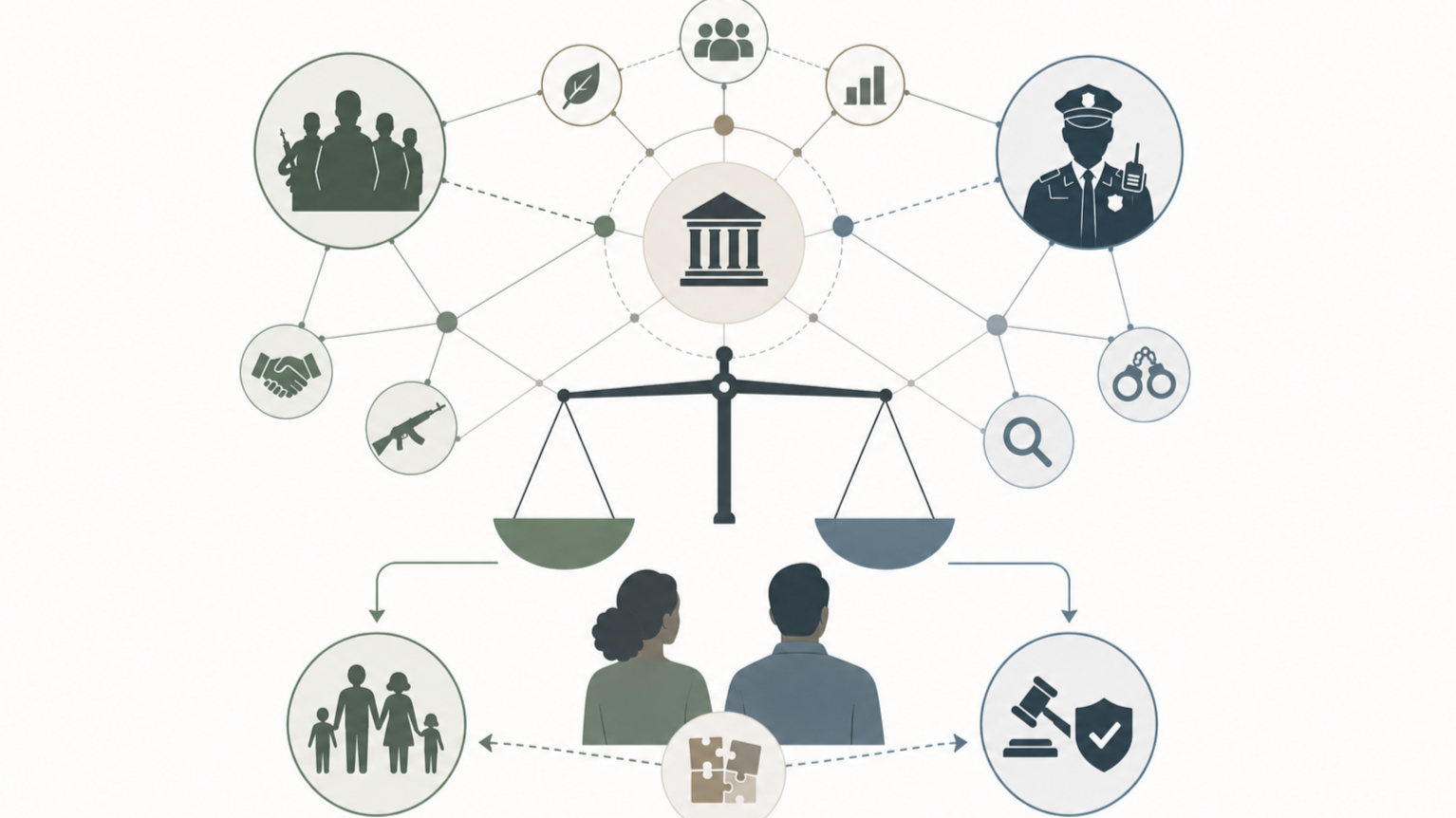
Paramilitaries and Organised Crime in War-to-Peace Transitions: Policy Challenges and
Responses
How have policymakers sought to address the paramilitary-organised crime nexus, what are the challenges and what are the lessons? Read here…

Paramilitary-Organised Crime Nexus: A framework for policymakers
A framework for assessing policy responses to the paramilitary-organised crime nexus from Goodhand and Meehan. Read here…
Paramilitary-Organised Crime Nexus: Implications for supporting peace processes
How does the paramilitary–organised crime nexus shape war‑to‑peace transitions, and what are the implications for peace process support? Read here…

Paramilitary-Organised Crime Nexus: Implications for DDR and SSR Programmes
DDR/SSR in paramilitary-affected contexts requires tailored strategies, improved intelligence & analysis, conditionality for participation, and government coordination. Read here…

Paramilitary-Organised Crime Nexus: Implications for Development Programming
What should development actors consider when programming to address paramilitary-organised crime nexus in war-to-peace transitions? Read here…
Paramilitary-Organised Crime Nexus: Implications for Addressing Organised Crime
How to address organised crime when paramilitary criminal activities are embedded in political, territorial and governance systems rather than being solely profit-driven? Read here…
Undertaking Political Economy Analysis of the Paramilitary–Organised Crime Nexus
A practical tool to guide policymakers and practitioners in undertaking political economy analysis of the paramilitary-organised crime nexus. Read here…

N. Ireland Case Study: A ‘Public Health’ Approach to the Paramilitary-Organised Crime Nexus
Integrated, cross-department, community-based approaches can help reduce paramilitary harm and legitimacy but are unlikely to secure disbandment on their own. Read here…
Myanmar Case Study: The Paramilitary-Organised Crime Nexus in Borderlands
Responses must recognise the structural role of militias, focus on financial and criminal networks, mitigate harms and engage seriously with the opportunities and limitations of working with regional powers. Read here…
Read publications from Jonathan Goodhand and Patrick Meehan from their overarching research project, Parastatal Armed Groups, Illicit Economies and Organised Crime.

Coercive Brokerage: The Paramilitary-Organized Crime Nexus in Borderlands and Frontiers
Explores the nexus between paramilitaries, illicit economies and organised crime, advancing a conceptual framework for analysing in borderland and frontier regions. Read here….
Coercive Brokerage: Paramilitaries, Illicit Economies and Organised Crime in the Frontiers of Afghanistan, Colombia
Examines the nexus between paramilitaries, illicit economies and organised crime through case studies of Afghanistan, Myanmar and Colombia borderlands. Read here…