
PUBLICATIONS
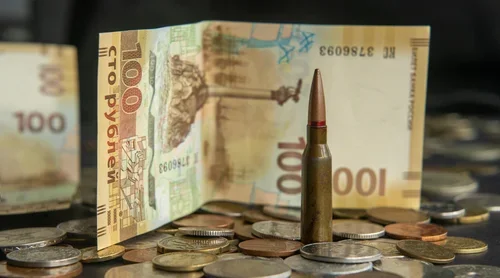
Russian War-Related Illicit Trade in the Black Sea: International Networks and Policy Options
The war in Ukraine is fought not only on the battlefield but also through vast illicit trade networks that continue to generate revenue, evade sanctions and sustain Russia's military capabilities. This research uncovers the commercial, financial and maritime networks enabling these activities and explores how governments and businesses can better disrupt them.
Olivia Allison
Joshua Coyle
July 2026

Women and Illicit Finance in Russia’s Occupation of Ukraine
This research paper takes a gendered view of Russia’s use of illicit financial flows (IFF) in occupied Ukraine, by examining the role of women as both victims and perpetrators. The paper sheds light on the overlooked role that women are playing, be that - implementing corrupt policies, acting as proxies, or surviving under duress - while facing systemic harm, coercion, and prosecution amid gendered norms.
Dr Orly Stern
Olivia Allison (University of Exeter)
October 2025

Looting Mariupol: Russia’s use of illicit finance and economic crime in occupied Ukraine
Who benefits from Russia's occupation of Ukraine? Russia's economic activities in the occupied territories are characterised by widespread corruption and profiteering off billions spent without accountability and illicit seizures of Ukrainian businesses, many of which may be war crimes. These activities create new networks and bolster vested interests, often linked to Russian security services.
Olivia Allison, David Lewis
May 2025

Economic Crime and Illicit Finance in Russia’s Occupation Regime in Ukraine
This paper details Russia's illicit economic activity in the occupied territories in Ukraine and calls for more international attention to this aspect of Russia's invasion. The report shows that since Russia occupied large parts of south-eastern Ukraine in March 2022, it has worked rapidly to incorporate these regions into Russia's economic and financial system. These activities were all illegal under Ukrainian law and some may constitute potential war crimes under international law.
Professor David Lewis
September 2023

Russian illicit financial flows and influence on Western European politics
This briefing note analyses Russian illicit financial flows (IFF) and its possible influence on political parties and the wider body politic of western Europe. It argues for the need to place more focus on certain individuals, companies, and relationships, given the legal vagaries of financial flows linked to the Russian state. As Russia’s investigative units, prosecutorial bodies, and law courts lack independence, the vast majority of Russian IFF may not be illegal under Russian law (or at least a Russian court will not rule it to be) but could still constitute IFF and could be used for malign purposes in the countries where it is found.
Thomas Mayne
May 2022
The illicit financialisation of Russian foreign policy: mapping the practices that facilitate Russia’s illicit financial flows
This paper categorises the practices used by Russian Kremlin-connected actors to advance Russian illicit financial flows (IFF) and depicts them, as well as their relationships to one another and to IFF in a novel framework. It argues that conclusively identifying and tracing IFF in authoritarian environments is very difficult due to the politicised nature of authoritarian legal systems and the inevitable data gaps. Our framework seeks to remedy these challenges by mapping malign practices, enacted by Russian actors in collaboration with elite overseas partners to create conditions friendly to Russian IFF, across three vectors: 1) political activities, 2) media activities and 3) political violence. We argue that the deployment of these practices is deeply connected to Russian foreign policy objectives, which are built in part on informal and patronal relationships with domestic elites. Thus, the principal actors in Russian foreign policymaking and -doing are not state institutions but elites, intermediaries, private companies, and organised crime groups.
Catherine Owen, Tena Prelec & Tom Mayne
May 2022

Corruption, crime and conflict in eastern Ukraine
This short evidence review paper, written before February 2022, looks at the links between corruption, crime and conflict in eastern Ukraine. As well as explaining the background to the conflict in eastern Ukraine (at the time of writing), the paper also looks at the pre-conflict situation with regard to organised crime and corruption and how organised crime and corruption play a role in, and have been impacted by, the conflict.
Iffat Idris
May 2022