
PUBLICATIONS
Russian War-Related Illicit Trade in the Black Sea: International Networks and Policy Options
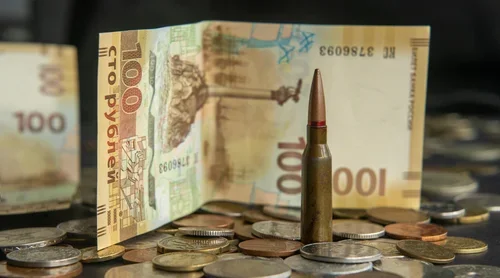
The war in Ukraine is fought not only on the battlefield but also through vast illicit trade networks that continue to generate revenue, evade sanctions and sustain Russia's military capabilities. This research uncovers the commercial, financial and maritime networks enabling these activities and explores how governments and businesses can better disrupt them.
Olivia Allison
Joshua Coyle
July 2026

Flying money, hidden threat: Understanding the growth of Chinese Money Laundering Organisations
In this research paper, Kathryn Westmore examines the rapid development of Chinese Money Laundering Organisations (CMLOs), describing their history and expansion in the West. She analyses them within a state threats framework and discusses the policy implications.
Kathryn Westmore (RUSI)
November 2025

Women and Illicit Finance in Russia’s Occupation of Ukraine
This research paper takes a gendered view of Russia’s use of illicit financial flows (IFF) in occupied Ukraine, by examining the role of women as both victims and perpetrators. The paper sheds light on the overlooked role that women are playing, be that - implementing corrupt policies, acting as proxies, or surviving under duress - while facing systemic harm, coercion, and prosecution amid gendered norms.
Dr Orly Stern
Olivia Allison (University of Exeter)
October 2025

Looting Mariupol: Russia’s use of illicit finance and economic crime in occupied Ukraine
Who benefits from Russia's occupation of Ukraine? Russia's economic activities in the occupied territories are characterised by widespread corruption and profiteering off billions spent without accountability and illicit seizures of Ukrainian businesses, many of which may be war crimes. These activities create new networks and bolster vested interests, often linked to Russian security services.
Olivia Allison, David Lewis
May 2025

The Role of Financial Rewards for Whistleblowers in the Fight Against Economic Crime
This paper evaluates the evidence on the use of reward programmes for whistleblowers who report economic crimes, evaluating it against the key concerns in the debate surrounding the implementation of such schemes. It offers four observations for policymakers considering use of whistleblower rewards programmes in the fight against economic crime.
Eliza Lockhart
December 2024

Information Manipulation and Organised Crime: Examining the Nexus
In recent years, concerns over information manipulation have grown, particularly the disinformation tactics employed by authoritarian regimes. Yet, the role of non-state actors, specifically organised crime (OC) groups, in shaping information landscapes remains overlooked. Drawing from Nicholas Barnes' 'political criminality' concept, this paper investigates the complex connections between criminal actors and the state. The research spans various regions, with a strong focus on Eastern Europe, including Ukraine, Russia, Moldova (Transnistria), and Albania.
Dr Tena Prelec
October 2023

Illuminating the Role of Third-Country Jurisdictions in Sanctions Evasion and Avoidance (SEA)
Sanctions are a crucial tool for exerting influence internationally yet understanding of the impact of sanctions evasion or avoidance (SEA) and third-country involvement is limited. This report reveals that third countries are more likely to engage in SEA when they have trade and commercial capacity, particularly in professional advisory, financial services, shipping and logistics sectors. Private commercial actors within these sectors, with an economic interest in engaging in SEA may find opportunity to do so.
Dr Liam O’Shea, Olivia Allison, Gonzalo Saiz & Alexia Anna Hack
October 2023

Economic Crime and Illicit Finance in Russia’s Occupation Regime in Ukraine
This paper details Russia's illicit economic activity in the occupied territories in Ukraine and calls for more international attention to this aspect of Russia's invasion. The report shows that since Russia occupied large parts of south-eastern Ukraine in March 2022, it has worked rapidly to incorporate these regions into Russia's economic and financial system. These activities were all illegal under Ukrainian law and some may constitute potential war crimes under international law.
Professor David Lewis
September 2023

Under the Radar: How Russia Outmanoeuvres Western Sanctions with Help from its Neighbours
This paper examines the practices used to evade sanctions imposed on Russia after its invasion of Ukraine in 2022, focusing on the import–export operations of Russia, Belarus, Georgia, and Kazakhstan. The research finds that sanctions have not cut supplies to Russia but have instead empowered informal trade networks and intermediaries. Georgia and Kazakhstan have indirectly benefited from the increased transiting trade; however, the impact on the shadow economy and traditional organised crime has been minimal because sanctions-busting is not illegal in these countries.
Dr Erica Marat & Dr Alexander Kupatadze
August 2023

New dynamics in illicit finance and Russian foreign policy
This paper provides an analytical overview of how Russian actors and proxies are using illicit financial flows (IFF) to support Russian foreign policy goals. It shows how Russia has used illicit finance to fund political interference campaigns, promote disinformation, and support military operations outside Russia, including the international activities of the Wagner network. It calls for a holistic approach to tackling the issue by combining effective sanctions with systematic efforts to tackle money-laundering and illicit finance in key financial and logistical hubs, including in the UK and other Western countries.
Professor David Lewis & Dr Tena Prelec
August 2023

How to seize a billion: exploring mechanisms to recover the proceeds of kleptocracy
This briefing note summarises research that explores alternative asset recovery mechanisms that could help respond to the immediate policy goal surrounding Russian-linked sanctioned assets, and also contribute to strengthening the broader asset recovery framework in the UK for the longer term.
Maria Nizzero
March 2023

Opium, meth and the future of international drug control in Taliban Afghanistan
With the fall of Kabul in August 2021, the Taliban swept back to power with almost shocking speed and coherence. This was despite two decades of intervention and state-building efforts by NATO powers, which had sought to forestall precisely this outcome. This failure of a direct intervention strategy raised immediate questions over the future shape of Afghanistan’s drug policies and how it would engage with multilateral forums such as the United Nations. The UN drug control system will have to contend with whether and how Afghanistan and UN member states can find a way to cooperate over the country’s drug policies, through anti-organised crime treaty and other frameworks. The Taliban’s April 2022 announcement of the reintroduction of an opium production ban has revived one of the key questions around its similar policy in the early 2000s: is this a sustainable and sincere move, or an opportunistic or impossible intervention?
John Collins, Shehryar Fazli & Ian Tennant
November 2022

Politics, uncertainty and interoperability challenges: the potential for sensemaking to improve multi-agency approaches
This scoping research looks at the potential for sensemaking for tackling challenges that arise when multi-agency teams are tasked with tackling the same problems – in this case, serious organised crime – but with unclear and potentially competing or conflicting mandates and incentives. We look at how sensemaking can help in better uncovering the ways in which different agencies approach the problem focusing on framing effects (e.g., assumptions, beliefs, desired consequences, expected risks and so on). We consider how this can lead to differences in consequences and potential for conflict and suggest an approach for improved multi-agency analysis and decision-making.
Chris Baber, Andrew Howes, James Knight & Heather Marquette
August 2022

Illicit financing in Afghanistan: methods, mechanisms and threat-agnostic disruption opportunities
Illicit actors in Afghanistan, including drug traffickers, warlords, terrorist groups, and even former government officials, exploit the country to achieve their own political and economic objectives. This paper provides a historical and contemporary overview of illicit financing activities in Afghanistan. It uses a terrorist financing framework to explain the various mechanisms involved in how illicit actors raise, use, move, store, manage, and obscure their funds. Specific jurisdictions used for illicit finance and global financial vulnerabilities that illicit actors with a nexus to Afghanistan exploit in their financial activities are discussed, outlining the threat-agnostic capabilities that could tackle some of these illicit financial challenges.
Jessica Davis
May 2022
Russian illicit financial flows and influence on Western European politics
This briefing note analyses Russian illicit financial flows (IFF) and its possible influence on political parties and the wider body politic of western Europe. It argues for the need to place more focus on certain individuals, companies, and relationships, given the legal vagaries of financial flows linked to the Russian state. As Russia’s investigative units, prosecutorial bodies, and law courts lack independence, the vast majority of Russian IFF may not be illegal under Russian law (or at least a Russian court will not rule it to be) but could still constitute IFF and could be used for malign purposes in the countries where it is found.
Thomas Mayne
May 2022
Mapping Russian illicit finance in Africa: the cases of Sudan and Madagascar
This briefing note shows how Russian foreign policy in Africa facilitates illicit financial flows (IFF) into and out of the continent through two case studies. First, in Sudan, gold-mining ventures, supported by military investments, are being exploited by Russian and Sudanese political elites hit by Wester economic sanctions. Second, in Madagascar, Russian ‘political technologists’ influenced electoral processes by cultivating anti-Western sentiments and supporting Moscow-friendly candidates.
Catherine Owen
May 2022
Combating money laundering: does implementing the Financial Action Task Force recommendations bite?
The Financial Action Task Force (FATF) focuses on combatting money laundering. In February 2012, it codified its recommendations, ‘FATF Recommendations 2012’, consisting of a framework of measures and international standards to combat money laundering and terrorist financing. Once a country agrees to follow the recommendations, it has to produce its anti-money laundering (AML) framework that FATF can assess. In this paper, we attempt to answer a simple question: is this working? We look at a group of eight countries in Africa and the Middle East that in the 2012– 2020 period have voluntarily agreed to implement these recommendations and test whether suspected illicit financial flows (IFF), measured through the trade-gap methods, decline after the decision to implement FATF recommendations. Our results point to a reduction of the trade gap characterising tax avoidance through import under-invoicing and/or Trade Based Money Laundering (TBML) through export over-invoicing.
Sami Bensassi & Arisyi Fariza Raz
May 2022
The illicit financialisation of Russian foreign policy: mapping the practices that facilitate Russia’s illicit financial flows
This paper categorises the practices used by Russian Kremlin-connected actors to advance Russian illicit financial flows (IFF) and depicts them, as well as their relationships to one another and to IFF in a novel framework. It argues that conclusively identifying and tracing IFF in authoritarian environments is very difficult due to the politicised nature of authoritarian legal systems and the inevitable data gaps. Our framework seeks to remedy these challenges by mapping malign practices, enacted by Russian actors in collaboration with elite overseas partners to create conditions friendly to Russian IFF, across three vectors: 1) political activities, 2) media activities and 3) political violence. We argue that the deployment of these practices is deeply connected to Russian foreign policy objectives, which are built in part on informal and patronal relationships with domestic elites. Thus, the principal actors in Russian foreign policymaking and -doing are not state institutions but elites, intermediaries, private companies, and organised crime groups.
Catherine Owen, Tena Prelec & Tom Mayne
May 2022

Corruption, crime and conflict in eastern Ukraine
This short evidence review paper, written before February 2022, looks at the links between corruption, crime and conflict in eastern Ukraine. As well as explaining the background to the conflict in eastern Ukraine (at the time of writing), the paper also looks at the pre-conflict situation with regard to organised crime and corruption and how organised crime and corruption play a role in, and have been impacted by, the conflict.
Iffat Idris
May 2022

Political will and combatting serious organised crime
This evidence review explores the literature on political will in relation to organised crime, kleptocracy, illicit finance, sanctions, trafficking and COVID-19. Findings demonstrate the importance of political will for effectively tackling SOC, illicit finance and transnational corruption, but also why it is so challenging to find political will, measure it and create demand for it.
Iffat Idris
May 2022