
The Overlooked Economy: The Rise of Criminal Markets in Legal Commodities
June 2026
The RUSI Journal, 171(4), 30-33
Dr Alexander Kupatadze (King’s College London)
SOC ACE Project: Exploring the Consequences of Organised Crime and Illegal Trade Displacement on Eurasia
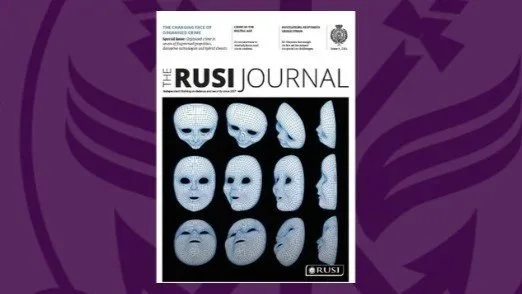
PUBLICATION SUMMARY
Organised crime is increasingly moving beyond traditional markets such as drugs, extortion and human trafficking into the illicit trade of legal commodities. From counterfeit pharmaceuticals and consumer goods to tobacco smuggling and fuel fraud, criminal networks are exploiting legitimate supply chains to generate substantial profits while reducing operational risks.
Although organised crime research has traditionally focused on illegal goods, illicit trade in legal commodities has become a significant global challenge. Counterfeit and pirated products are estimated to account for up to 2.5–3.3% of global trade, yet these markets remain comparatively under-recognised despite their rapid growth.
Compared with trafficking prohibited goods, counterfeit production and excise fraud often carry lower penalties while delivering comparable financial returns. This has encouraged criminal groups to diversify into sectors including consumer products, agriculture, logistics and food distribution, using existing networks to exploit new opportunities. Markets for illicit tobacco and counterfeit medicines are now estimated to rival some of the world's largest illegal economies.
The research identifies criminogenic asymmetries as a key driver of illicit trade. Differences in tax regimes, regulations and enforcement across borders create profitable opportunities for smuggling, while sanctions, tariffs and trade restrictions can unintentionally encourage shadow trade networks and criminal intermediaries.
Perhaps most significantly, the paper highlights how organised crime is increasingly embedded within legitimate global commerce. Illicit goods move through the same ports, shipping routes, warehouses and logistics providers as legal products, allowing criminal groups to conceal illegal activity within ordinary supply chains. Once access to these networks is secured, the same infrastructure can be used to transport a wide range of commodities, adapting quickly to changing market conditions.
The paper concludes that organised crime should no longer be viewed solely through the lens of prohibited goods. Instead, it argues that illicit trade in legal commodities has become a defining feature of contemporary organised crime, blurring the boundaries between legal and illegal economies and demonstrating how criminal networks increasingly exploit the systems that underpin global trade.
RELATED PUBLICATIONS

Criminal Geographies: How the Russo-Ukrainian War Reshaped Global Crime Networks
Dr Alexander Kupatadze (KCL), Prof. Erica Marat (NDU)

Under the Radar: How Russia Outmanoeuvres Western Sanctions with Help from its Neighbours
Dr Erica Marat, National Defense University, Dr Alexander Kupatadze, King’s College London
Russian War-Related Illicit
Trade in the Black Sea:
International Networks
and Policy Options
Olivia Allison, Joshua Coyle
Read here…
